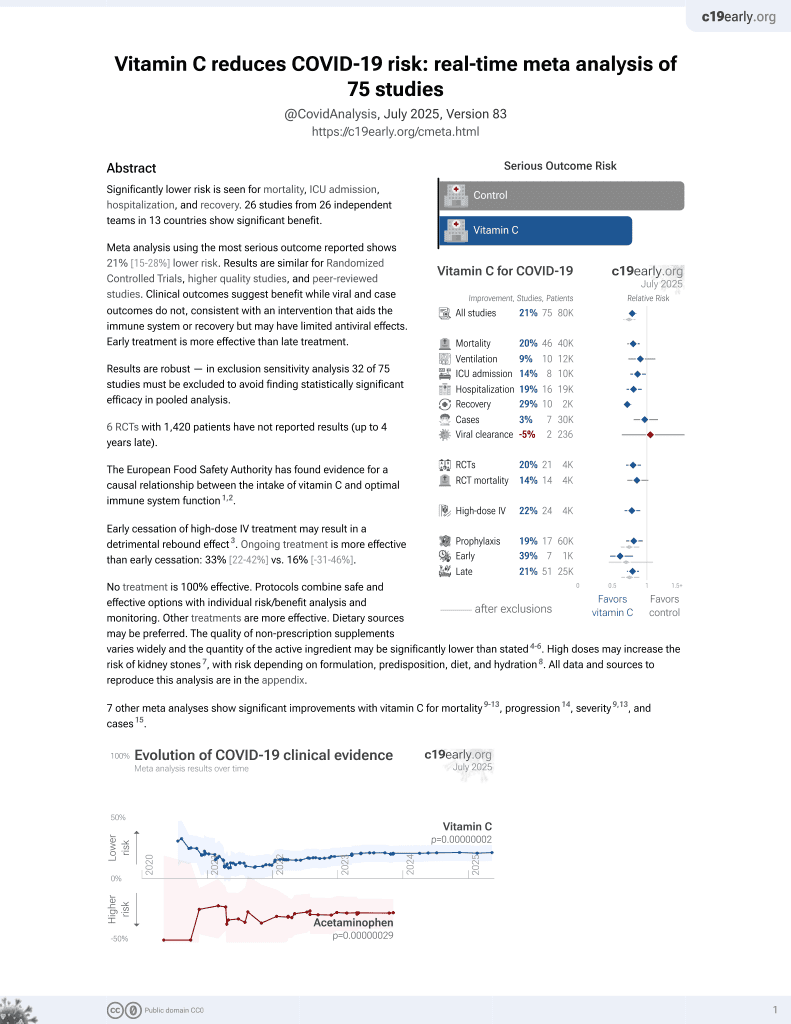
Vitamin C for COVID-19
6th treatment shown to reduce risk in
September 2020, now with p = 0.000000069 from 72 studies, recognized in 22 countries.
No treatment is 100% effective.
Protocols combine treatments.

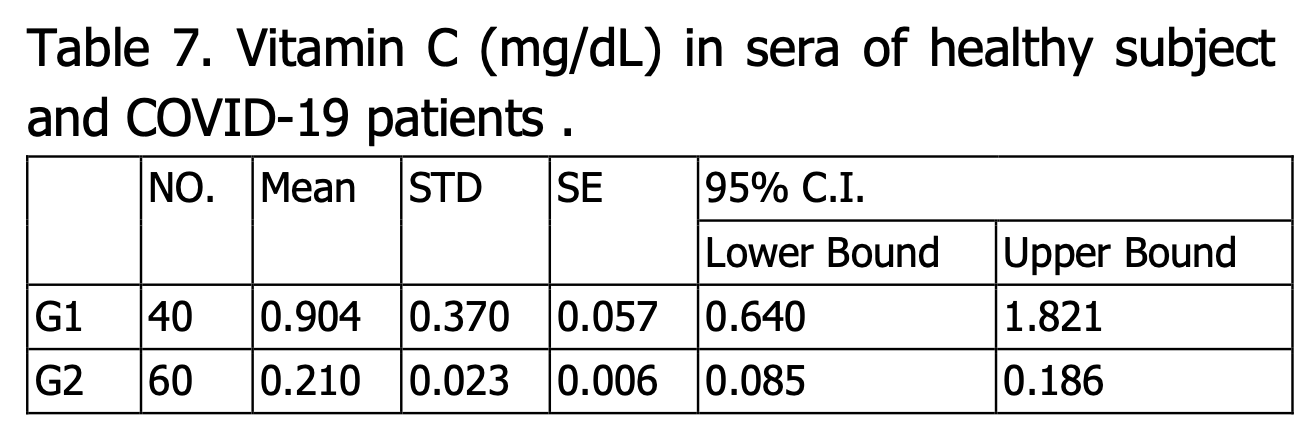
Cross-sectional study of 60 COVID-19 patients and 40 healthy controls showing significant oxidative stress imbalance, with elevated copper and total oxidant status, and decreased selenium and vitamin C levels in COVID-19 patients compared to healthy subjects.
Study covers selenium and vitamin C.

Hamza et al., 30 Jun 2026, Iraq, peer-reviewed, 2 authors.
Contact: tholfikar_ahmed@uomus.edu.iq.
Abstract: 1, * (D
n21D
Estimation of Oxidative Stress, Antioxidants and Trace Elements in COVID-19 Patients
Check for
ABRAN (®
COVID-19
ASSOCIACÃO BRASILEIRA
updates
Patients
DE NUTROLOGIA
(n=60)
Trace Elements
1 Copper (Cu)
· Selenium (Se)
Healthy Controls
International Journal of Nutrology
(Official Journal of the ABRAN - Brazilian Association of Nutrology) (n=40) Blood Samples Analysis
Oxidative Stress
+ Total Oxidant
Status (TOS)
TOS
SARS-CoV-2 Infection
1 Reactive Oxygen Species
ROS
Antioxidants
- Vitamin C
IMBALANCE
1 Antioxidant Depletion
Estimation of oxidative stress, antioxidants and trace elements for COVID-19 patients: a cross-sectional study
Antioxidant Levels & Trace Element Imbalance
Thulfeqar A. Hamza 1,* , Rafal Fawze Kaream 2 Churco. Guin siltharchin
- 1 Al-Mustaqbal University. Medical Laboratory Department, Hilla City, Babylon Governorate, Iraq.
2 Al-Mustaqbal University. Medicinal Plants and Natural Products Department, Hilla City, Babylon Governorate, Iraq.
*Corresponding author: Thulfeqar A. Hamza.
Al-Mustaqbal University. Medical Laboratory Department,
Hilla City, Babylon Governorate, Iraq.
E-mail: tholfikar\_ahmed@uomus.edu.iq
DOI: https://doi.org/10.54448/ijn26227
Received: 04-25-2026; Revised: 06-26-2026; Accepted: 06-27-2026; Published: 06-30-2026; IJN-id: 26227
DOI: https://doi.org/10.54448/ijn26227
Received: 04-25-2026; Revised: 06-26-2026; Accepted: 06-27-2026; Published: 06-30-2026; IJN-id: 26227
Editor:
Dr. Carla Maria Barreto da Silva de Sousa Rego, MD, MsD, Ph.D.
Abstract
Introduction: The World Health Organization announced coronavirus-disease 2019 (COVID-19) to be a global pandemic. Recently oxidative stress has implicated in the pathogenesis of COVID-19. The buildup of free radicals together with the inability of the antioxidant system to counterbalance the free radicals produces oxidative stress which ultimately exacerbate respiratory diseases including COVID-19 . Objective: This was a study to explore the impact of corona virus 2019 (COVID-19) on blood oxidants and antioxidants. Methods: A total of blood samples were taken from (60) patients infected with COVID-19 and 40 volunteers as a control group. Results: The Copper levels that show a significant increase of Copper levels in the COVID-19 patients compared to the healthy subjects, and Selenium levels show a significant decrease of Selenium levels for the COVID-19 patients compared to the healthy subjects, and total oxidant levels show a very high significant increase of COVID19 patients compared to the healthy subjects, and Vitamin C levels show a significant decrease of Vitamin C levels for the COVID-19 patients compared to the healthy subjects. Conclusion , in COVID-19 positive patients, the levels of the antioxidant substances are decreased as they are progressively consumed to balance the injurious effect of the free radicals.
Keywords: COVID-19. Trace elements. Oxidative stress. Vitamin C.
Graphical Abstract
Source: Own authorship.
DOI record:
{
"DOI": "10.54448/ijn26227",
"ISSN": [
"2595-2854",
"1984-3011"
],
"URL": "http://dx.doi.org/10.54448/ijn26227",
"abstract": "<jats:p>Introduction: The World Health Organization announced coronavirus-disease 2019 (COVID-19) to be a global pandemic. Recently oxidative stress has implicated in the pathogenesis of COVID-19. The buildup of free radicals together with the inability of the antioxidant system to counterbalance the free radicals produces oxidative stress which ultimately exacerbate respiratory diseases including COVID-19. Objective: This was a study to explore the impact of corona virus 2019 (COVID-19) on blood oxidants and antioxidants. Methods: A total of blood samples were taken from (60) patients infected with COVID-19 and 40 volunteers as a control group. Results: The Copper levels that show a significant increase of Copper levels in the COVID-19 patients compared to the healthy subjects, and Selenium levels show a significant decrease of Selenium levels for the COVID-19 patients compared to the healthy subjects, and total oxidant levels show a very high significant increase of COVID-19 patients compared to the healthy subjects, and Vitamin C levels show a significant decrease of Vitamin C levels for the COVID-19 patients compared to the healthy subjects. Conclusion, in COVID-19 positive patients, the levels of the antioxidant substances are decreased as they are progressively consumed to balance the injurious effect of the free radicals.\nGraphical Abstract</jats:p>",
"author": [
{
"ORCID": "https://orcid.org/0009-0006-6214-9582",
"affiliation": [],
"authenticated-orcid": false,
"family": "Hamza",
"given": "Thulfeqar A.",
"role": [
{
"role": "author",
"vocabulary": "crossref"
}
],
"sequence": "first"
},
{
"ORCID": "https://orcid.org/0009-0005-6413-5902",
"affiliation": [],
"authenticated-orcid": false,
"family": "Kaream",
"given": "Rafal Fawze",
"role": [
{
"role": "author",
"vocabulary": "crossref"
}
],
"sequence": "additional"
}
],
"container-title": "International Journal of Nutrology",
"container-title-short": "Int. J. Nutrology",
"content-domain": {
"crossmark-restriction": false,
"domain": []
},
"created": {
"date-parts": [
[
2026,
7,
1
]
],
"date-time": "2026-07-01T10:24:08Z",
"timestamp": 1782901448000
},
"deposited": {
"date-parts": [
[
2026,
7,
1
]
],
"date-time": "2026-07-01T12:38:42Z",
"timestamp": 1782909522000
},
"indexed": {
"date-parts": [
[
2026,
7,
1
]
],
"date-time": "2026-07-01T12:55:38Z",
"timestamp": 1782910538547,
"version": "3.54.5"
},
"is-referenced-by-count": 0,
"issue": "2",
"issued": {
"date-parts": [
[
2026,
6,
30
]
]
},
"journal-issue": {
"issue": "2",
"published-online": {
"date-parts": [
[
2026,
3,
12
]
]
}
},
"license": [
{
"URL": "https://creativecommons.org/licenses/by/4.0",
"content-version": "unspecified",
"delay-in-days": 0,
"start": {
"date-parts": [
[
2026,
6,
30
]
],
"date-time": "2026-06-30T00:00:00Z",
"timestamp": 1782777600000
}
}
],
"link": [
{
"URL": "https://ijn.zotarellifilhoscientificworks.com/index.php/ijn/article/download/585/529",
"content-type": "application/pdf",
"content-version": "vor",
"intended-application": "text-mining"
},
{
"URL": "https://ijn.zotarellifilhoscientificworks.com/index.php/ijn/article/download/585/529",
"content-type": "unspecified",
"content-version": "vor",
"intended-application": "similarity-checking"
}
],
"member": "32908",
"original-title": [],
"prefix": "10.54448",
"published": {
"date-parts": [
[
2026,
6,
30
]
]
},
"published-online": {
"date-parts": [
[
2026,
6,
30
]
]
},
"publisher": "Zotarelli-Filho Scientific Works",
"reference-count": 0,
"references-count": 0,
"relation": {},
"resource": {
"primary": {
"URL": "https://ijn.zotarellifilhoscientificworks.com/index.php/ijn/article/view/585"
}
},
"score": 1,
"short-title": [],
"source": "Crossref",
"subject": [],
"subtitle": [],
"title": "Estimation of oxidative stress, antioxidants and trace elements for COVID-19 patients: a cross-sectional study",
"type": "journal-article",
"volume": "19"
}
hamza2