Sunlight and Influenza Mortality in Scotland: Insights From the 1918 Influenza Pandemic and Later Flu Outbreaks
et al., International Journal of Population Data Science, doi:10.23889/ijpds.v11i5.3763, Jul 2026
Sunlight for COVID-19
No treatment is 100% effective.
Protocols combine treatments.
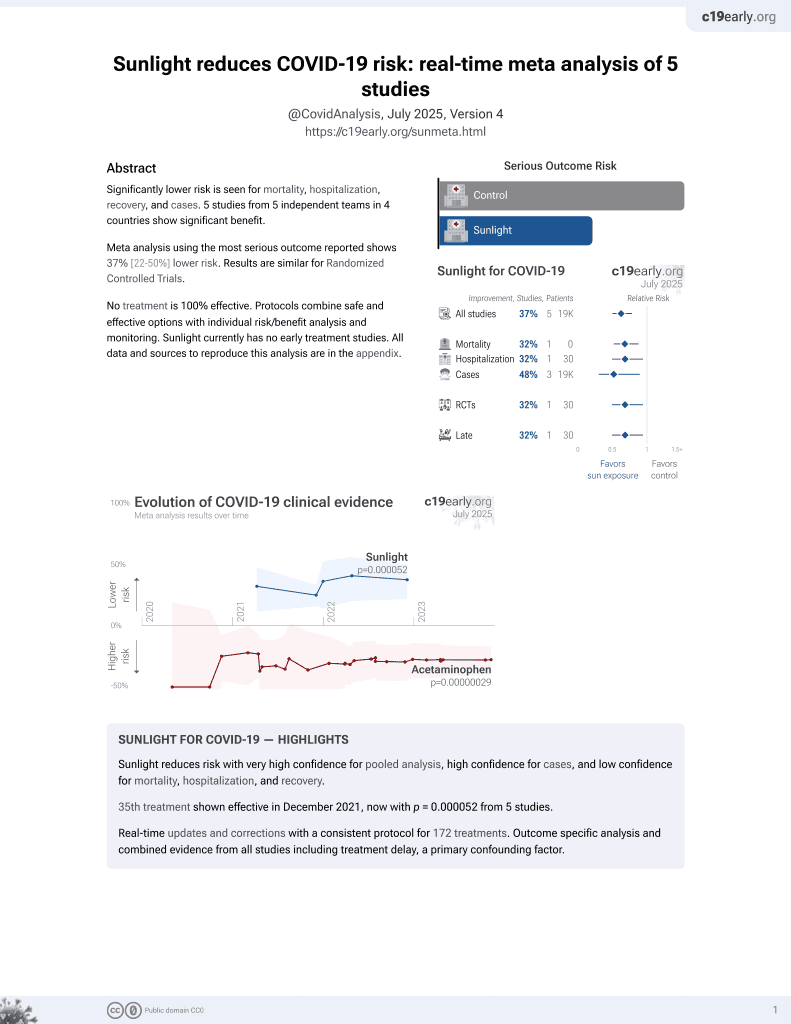
Non-COVID-19 retrospective ecological study using a time-stratified case-crossover design examining daily sunlight exposure and excess influenza mortality during the 1918 pandemic in Scotland, showing that a one standard deviation increase in 2-day average solar radiation was associated with significantly lower excess mortality. Authors hypothesize that UV-A exposure photomobilises nitric oxide (NO), which inhibits viral replication and modulates immune response, protecting infected individuals. Authors find that UV-B levels were too low during the Scottish winter waves to support vitamin D synthesis, pointing to a UV-A/NO pathway rather than a vitamin D mechanism.

Stevenson et al., 6 Jul 2026, Scotland, peer-reviewed, 3 authors.
Abstract: IJPDS
International Journal of
Population Data Science
Swansea University
International Journal of Population Data Science
Journal Website: www.ijpds.org
Sunlight and Influenza Mortality in Scotland: Insights From the 1918 Influenza Pandemic and Later Flu Outbreaks
Andrew Stevenson 1 , Lee Williamson 1 , and Chris Dibben 1
1 University of Edinburgh, Edinburgh, United Kingdom
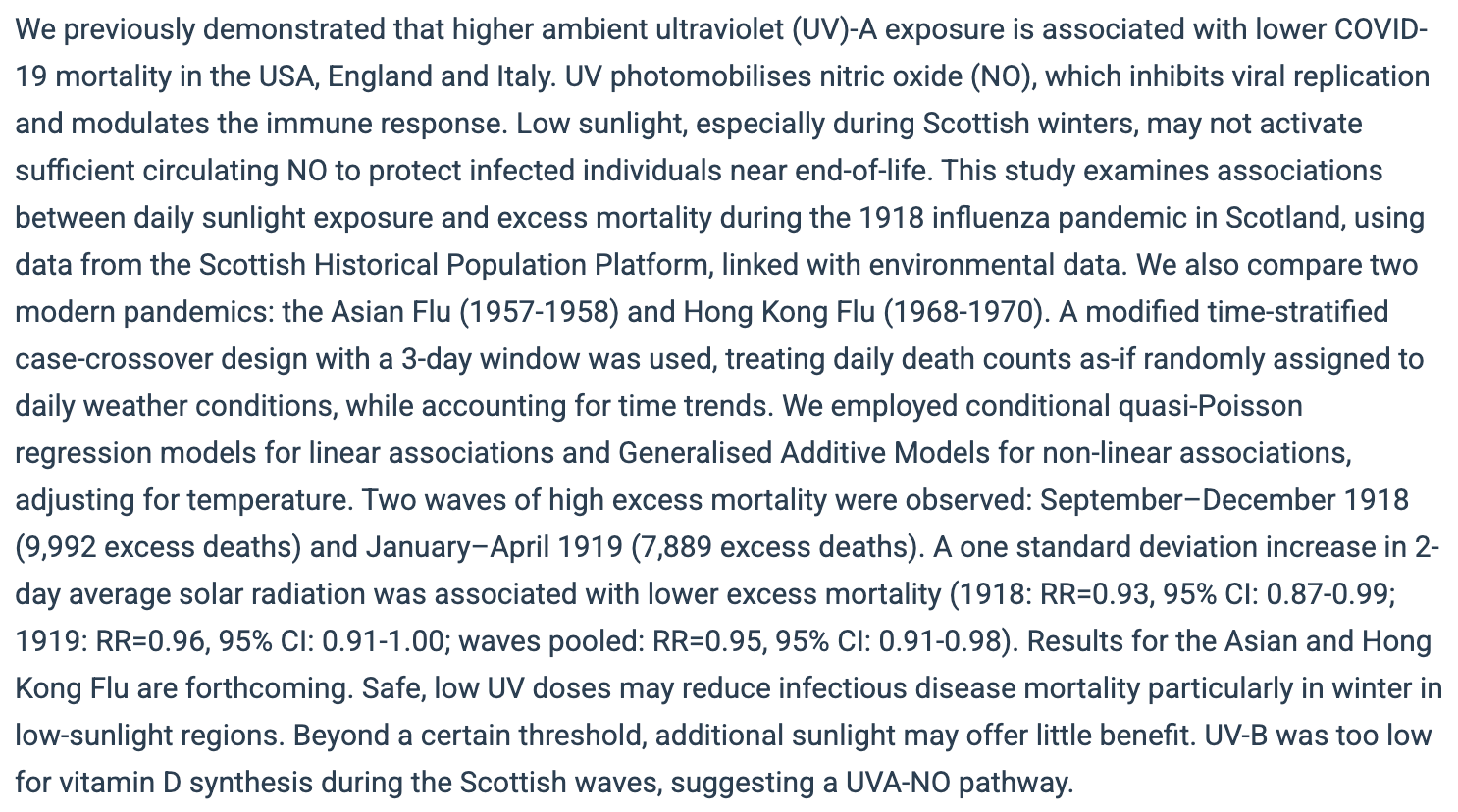
We previously demonstrated that higher ambient ultraviolet (UV)-A exposure is associated with lower COVID-19 mortality in the USA, England and Italy. UV photomobilises nitric oxide (NO), which inhibits viral replication and modulates the immune response. Low sunlight, especially during Scottish winters, may not activate sufficient circulating NO to protect infected individuals near end-of-life. This study examines associations between daily sunlight exposure and excess mortality during the 1918 influenza pandemic in Scotland, using data from the Scottish Historical Population Platform, linked with environmental data. We also compare two modern pandemics: the Asian Flu (1957-1958) and Hong Kong Flu (1968-1970). A modified time-stratified case-crossover design with a 3-day window was used, treating daily death counts as-if randomly assigned to daily weather conditions, while accounting for time
trends. We employed conditional quasi-Poisson regression models for linear associations and Generalised Additive Models for non-linear associations, adjusting for temperature. Two waves of high excess mortality were observed: SeptemberDecember 1918 (9,992 excess deaths) and January-April 1919 (7,889 excess deaths). A one standard deviation increase in 2-day average solar radiation was associated with lower excess mortality (1918: RR = 0.93, 95% CI: 0.87-0.99; 1919: RR = 0.96, 95% CI: 0.91-1.00; waves pooled: RR = 0.95, 95% CI: 0.91-0.98). Results for the Asian and Hong Kong Flu are forthcoming. Safe, low UV doses may reduce infectious disease mortality particularly in winter in low-sunlight regions. Beyond a certain threshold, additional sunlight may offer little benefit. UV-B was too low for vitamin D synthesis during the Scottish waves, suggesting a UVA-NO pathway.
DOI record:
{
"DOI": "10.23889/ijpds.v11i5.3763",
"ISSN": [
"2399-4908"
],
"URL": "http://dx.doi.org/10.23889/ijpds.v11i5.3763",
"abstract": "<jats:p>We previously demonstrated that higher ambient ultraviolet (UV)-A exposure is associated with lower COVID-19 mortality in the USA, England and Italy. UV photomobilises nitric oxide (NO), which inhibits viral replication and modulates the immune response. Low sunlight, especially during Scottish winters, may not activate sufficient circulating NO to protect infected individuals near end-of-life. This study examines associations between daily sunlight exposure and excess mortality during the 1918 influenza pandemic in Scotland, using data from the Scottish Historical Population Platform, linked with environmental data. We also compare two modern pandemics: the Asian Flu (1957-1958) and Hong Kong Flu (1968-1970). A modified time-stratified case-crossover design with a 3-day window was used, treating daily death counts as-if randomly assigned to daily weather conditions, while accounting for time trends. We employed conditional quasi-Poisson regression models for linear associations and Generalised Additive Models for non-linear associations, adjusting for temperature. Two waves of high excess mortality were observed: September–December 1918 (9,992 excess deaths) and January–April 1919 (7,889 excess deaths). A one standard deviation increase in 2-day average solar radiation was associated with lower excess mortality (1918: RR=0.93, 95% CI: 0.87-0.99; 1919: RR=0.96, 95% CI: 0.91-1.00; waves pooled: RR=0.95, 95% CI: 0.91-0.98). Results for the Asian and Hong Kong Flu are forthcoming. Safe, low UV doses may reduce infectious disease mortality particularly in winter in low-sunlight regions. Beyond a certain threshold, additional sunlight may offer little benefit. UV-B was too low for vitamin D synthesis during the Scottish waves, suggesting a UVA-NO pathway.</jats:p>",
"author": [
{
"affiliation": [],
"family": "Stevenson",
"given": "Andrew",
"role": [
{
"role": "author",
"vocabulary": "crossref"
}
],
"sequence": "first"
},
{
"affiliation": [],
"family": "Williamson",
"given": "Lee",
"role": [
{
"role": "author",
"vocabulary": "crossref"
}
],
"sequence": "additional"
},
{
"affiliation": [],
"family": "Dibben",
"given": "Chris",
"role": [
{
"role": "author",
"vocabulary": "crossref"
}
],
"sequence": "additional"
}
],
"container-title": "International Journal of Population Data Science",
"container-title-short": "IJPDS",
"content-domain": {
"crossmark-restriction": false,
"domain": []
},
"created": {
"date-parts": [
[
2026,
7,
6
]
],
"date-time": "2026-07-06T10:44:33Z",
"timestamp": 1783334673000
},
"deposited": {
"date-parts": [
[
2026,
7,
6
]
],
"date-time": "2026-07-06T10:44:33Z",
"timestamp": 1783334673000
},
"indexed": {
"date-parts": [
[
2026,
7,
6
]
],
"date-time": "2026-07-06T11:18:37Z",
"timestamp": 1783336717502,
"version": "3.54.6"
},
"is-referenced-by-count": 0,
"issue": "5",
"issued": {
"date-parts": [
[
2026,
7,
6
]
]
},
"journal-issue": {
"issue": "5",
"published-online": {
"date-parts": [
[
2026,
7,
6
]
]
}
},
"license": [
{
"URL": "http://creativecommons.org/licenses/by/4.0",
"content-version": "unspecified",
"delay-in-days": 0,
"start": {
"date-parts": [
[
2026,
7,
6
]
],
"date-time": "2026-07-06T00:00:00Z",
"timestamp": 1783296000000
}
}
],
"link": [
{
"URL": "https://ijpds.org/article/download/3763/7949",
"content-type": "application/pdf",
"content-version": "vor",
"intended-application": "text-mining"
},
{
"URL": "https://ijpds.org/article/download/3763/7950",
"content-type": "text/xml",
"content-version": "vor",
"intended-application": "text-mining"
},
{
"URL": "https://ijpds.org/article/download/3763/7949",
"content-type": "unspecified",
"content-version": "vor",
"intended-application": "similarity-checking"
}
],
"member": "9980",
"original-title": [],
"prefix": "10.23889",
"published": {
"date-parts": [
[
2026,
7,
6
]
]
},
"published-online": {
"date-parts": [
[
2026,
7,
6
]
]
},
"publisher": "Swansea University",
"reference-count": 0,
"references-count": 0,
"relation": {},
"resource": {
"primary": {
"URL": "https://ijpds.org/article/view/3763"
}
},
"score": 1,
"short-title": [],
"source": "Crossref",
"subject": [],
"subtitle": [],
"title": "Sunlight and Influenza Mortality in Scotland: Insights From the 1918 Influenza Pandemic and Later Flu Outbreaks",
"type": "journal-article",
"volume": "11"
}