Changes in Thyroid Function Parameters during Short-Term LowConcentration Povidone–Iodine Gargling in Young Adults with Asymptomatic SARS-CoV-2 Infection: A Single-Arm Prospective Cohort Study
et al., International Journal of Drug Delivery Technology, doi:10.25258/ijddt.16.46s.21, Jun 2026
PVP-I for COVID-19
No treatment is 100% effective.
Protocols combine treatments.
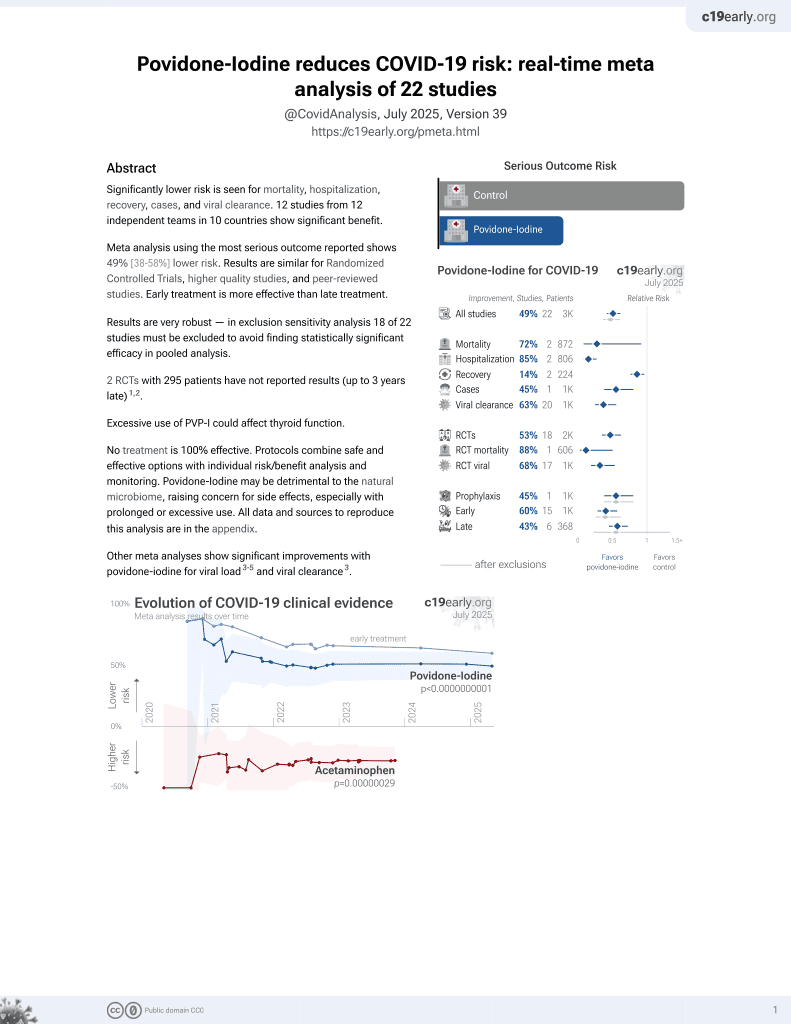
Prospective study of 45 young adults with asymptomatic SARS-CoV-2 infection showing no clinically significant thyroid dysfunction with short-term low-concentration povidone-iodine gargling.

Singh et al., 4 Jun 2026, prospective, India, peer-reviewed, 4 authors, study period April 2020 - May 2020.
Contact: jbsingh1@gmail.com (corresponding author), jbsingh1@gmail.com (corresponding author), jbsingh1@gmail.com (corresponding author), jbsingh1@gmail.com (corresponding author), shibusasi@gmail.com, manoj.congo@gmail.com, vishnuprasath2@gmail.com.
Abstract: ## RESEARCH PAPER
Changes in Thyroid Function Parameters during Short-Term LowConcentration Povidone-Iodine Gargling in Young Adults with Asymptomatic SARS-CoV-2 Infection: A Single-Arm Prospective Cohort Study
Jung Bahadur Singh 1* , Shibu Sasidharan 1 , Manoj Kumar Sharma 1 , Vishnuprasad R 2
1 Department of Anaesthesiology, Critical Care and Emergency Medicine, Base Hospital Delhi Cantonment, Delhi, India.
2 Specialist Community Medicine, Military Hospital, Jammu.
Email addresses:
JBS - jbsingh1@gmail.com SS - shibusasi@gmail.com MKS - manoj.congo@gmail.com
VR - vishnuprasath2@gmail.com
*Corresponding author: Dr Jung Bahadur Singh, Department of Anaesthesiology, Critical Care and Emergency Medicine, Base Hospital Delhi Cantonment, Delhi, India.
Email: jbsingh1@gmail.com
Abstract
Background. Povidone-iodine (PVP-I) gargles were widely recommended as an oropharyngeal antiseptic measure during the COVID-19 pandemic on the basis of in vitro virucidal activity against SARS-CoV-2. Repeated oral exposure to iodine-containing solutions raises theoretical concerns regarding systemic iodine absorption and thyroid homeostasis, including the Wolff-Chaikoff inhibitory effect and iodine-induced thyrotoxicosis. Empirical data on thyroid biochemistry during short-term, low-concentration PVP-I gargling in adults concurrently infected with SARS-CoV-2 are limited.
Objectives. To describe changes in serum free triiodothyronine (fT3), total thyroxine (TT4), and thyroid-stimulating hormone (TSH) in young euthyroid adults with asymptomatic SARS-CoV-2 infection during a standardised regimen of short-term, low-concentration PVP-I gargling, without inferring causality.
Methods. In this single-arm, single-centre, prospective cohort study conducted at a tertiary care hospital in Leh, Ladakh (April-May 2020), 45 inpatients aged 20-35 years with reverse transcription polymerase chain reaction (RT-PCR)confirmed, clinically asymptomatic SARS-CoV-2 infection and a normal baseline thyroid profile gargled once daily with 15 mL of 0.33% PVP-I solution (approximately 5 mg of available iodine per gargle) for 30 seconds at bedtime under direct nursing observation. Gargling continued until the first negative SARS-CoV-2 RT-PCR (10-15 days). Serum fT3, TT4, and TSH were measured at enrolment (Time A) and at first negative RT-PCR (Time B) on a single electrochemiluminescence immunoassay platform; paired samples from each participant were stored at -20 °C and processed in the same analytical run. Distributional normality was assessed by the Shapiro-Wilk test; paired comparisons used the paired t-test with Wilcoxon signed-rank as a sensitivity analysis. Standardised within-subject effect sizes (Cohen's dz) and Bonferroni-adjusted p-values were reported. A pre-specified sensitivity analysis stratified participants by exposure duration (≤ 12 vs > 12 days).
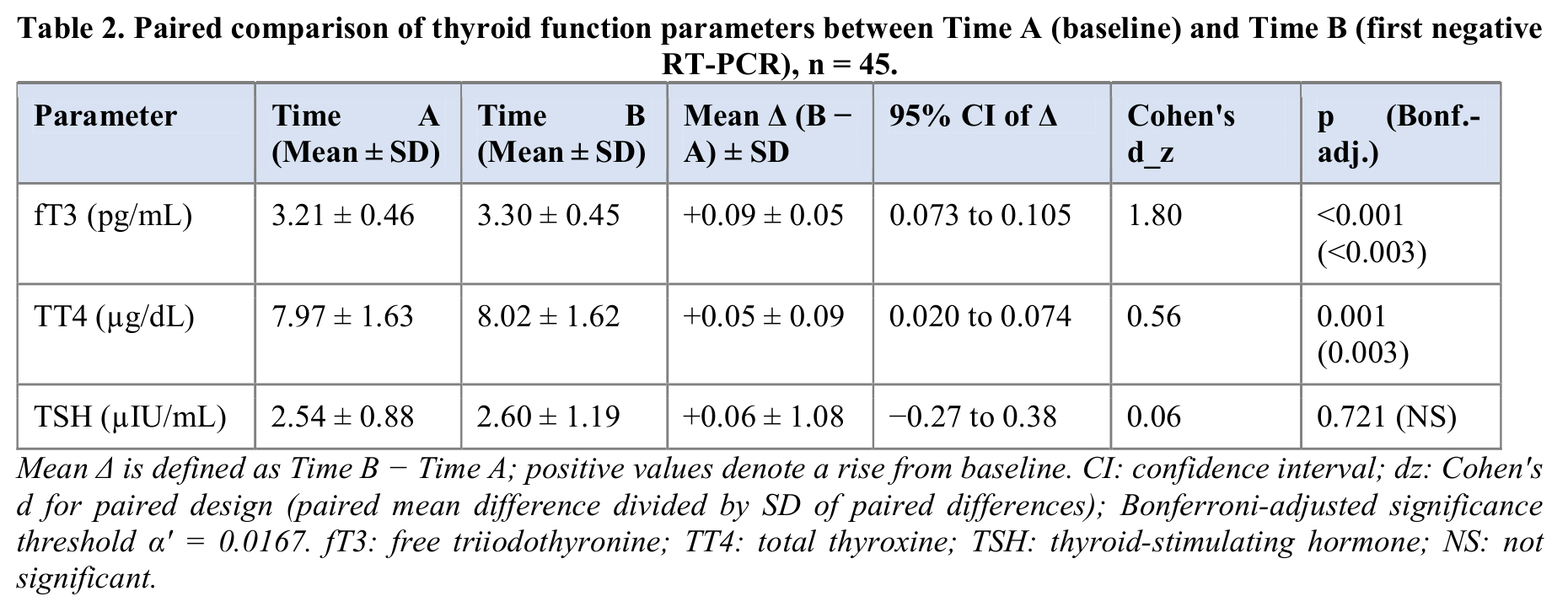
Results. Mean serum fT3 rose from 3.21 ± 0.46 pg/mL at Time A to 3.30 ± 0.45 pg/mL at Time B (mean change Time B - Time A = +0.09 pg/mL; 95% CI 0.073 to 0.105; dz = 1.80; p < 0.001; Bonferroni-adjusted p < 0.003). Mean serum TT4 rose from 7.97 ± 1.63 to 8.02 ± 1.62 µg/dL (mean change +0.05 µg/dL; 95% CI 0.020 to 0.074; dz = 0.56; adjusted p = 0.003). Serum TSH did not change significantly (2.54 ± 0.88 vs. 2.60 ± 1.19 µIU/mL; mean change +0.06 µIU/mL; 95% CI -0.27 to 0.38; dz = 0.06; p = 0.721). All thyroid parameters remained..
DOI record:
{
"DOI": "10.25258/ijddt.16.46s.21",
"ISSN": [
"0975-4415"
],
"URL": "http://dx.doi.org/10.25258/ijddt.16.46s.21",
"abstract": "<jats:p>Background. Povidone–iodine (PVP–I) gargles were widely recommended as an oropharyngeal antiseptic measure\nduring the COVID-19 pandemic on the basis of in vitro virucidal activity against SARS-CoV-2. Repeated oral exposure\nto iodine-containing solutions raises theoretical concerns regarding systemic iodine absorption and thyroid homeostasis,\nincluding the Wolff–Chaikoff inhibitory effect and iodine-induced thyrotoxicosis. Empirical data on thyroid biochemistry\nduring short-term, low-concentration PVP–I gargling in adults concurrently infected with SARS-CoV-2 are limited.\nObjectives. To describe changes in serum free triiodothyronine (fT3), total thyroxine (TT4), and thyroid-stimulating\nhormone (TSH) in young euthyroid adults with asymptomatic SARS-CoV-2 infection during a standardised regimen of\nshort-term, low-concentration PVP–I gargling, without inferring causality.\nMethods. In this single-arm, single-centre, prospective cohort study conducted at a tertiary care hospital in Leh, Ladakh\n(April–May 2020), 45 inpatients aged 20–35 years with reverse transcription polymerase chain reaction (RT-PCR)–\nconfirmed, clinically asymptomatic SARS-CoV-2 infection and a normal baseline thyroid profile gargled once daily with\n15 mL of 0.33% PVP–I solution (approximately 5 mg of available iodine per gargle) for 30 seconds at bedtime under\ndirect nursing observation. Gargling continued until the first negative SARS-CoV-2 RT-PCR (10–15 days). Serum fT3,\nTT4, and TSH were measured at enrolment (Time A) and at first negative RT-PCR (Time B) on a single\nelectrochemiluminescence immunoassay platform; paired samples from each participant were stored at −20 °C and\nprocessed in the same analytical run. Distributional normality was assessed by the Shapiro–Wilk test; paired comparisons\nused the paired t-test with Wilcoxon signed-rank as a sensitivity analysis. Standardised within-subject effect sizes\n(Cohen's dz) and Bonferroni-adjusted p-values were reported. A pre-specified sensitivity analysis stratified participants\nby exposure duration (≤ 12 vs > 12 days).\nResults. Mean serum fT3 rose from 3.21 ± 0.46 pg/mL at Time A to 3.30 ± 0.45 pg/mL at Time B (mean change Time B\n− Time A = +0.09 pg/mL; 95% CI 0.073 to 0.105; dz = 1.80; p < 0.001; Bonferroni-adjusted p < 0.003). Mean serum TT4\nrose from 7.97 ± 1.63 to 8.02 ± 1.62 µg/dL (mean change +0.05 µg/dL; 95% CI 0.020 to 0.074; dz = 0.56; adjusted p =\n0.003). Serum TSH did not change significantly (2.54 ± 0.88 vs. 2.60 ± 1.19 µIU/mL; mean change +0.06 µIU/mL; 95%\nCI −0.27 to 0.38; dz = 0.06; p = 0.721). All thyroid parameters remained within laboratory reference ranges, and no\nparticipant developed clinical thyroid dysfunction or local adverse effects. The observed directional pattern — a small\nrise in fT3 and TT4 with stable TSH — is not the suppressive signature classically predicted under an acute iodine load,\nand is compatible with non-iodine influences including recovery from low-T3 non-thyroidal illness syndrome during\nclearance of acute SARS-CoV-2 infection.\nConclusion. In this single-arm cohort without a non-exposed comparator, thyroid hormone trajectories during short-term,\nlow-concentration PVP–I gargling in young euthyroid adults with asymptomatic SARS-CoV-2 infection remained within\nthe laboratory reference range and showed no biochemical signature of acute iodine-induced thyroid inhibition. These\nfindings are compatible with — but cannot prove — the short-term thyroid safety of dilute PVP–I gargling; controlled\nstudies incorporating urinary iodine quantification and a non-exposed comparator are required for causal attribution.</jats:p>",
"author": [
{
"affiliation": [
{
"name": "Department of Anaesthesiology, Critical Care and Emergency Medicine, Base Hospital Delhi Cantonment, Delhi, India"
}
],
"family": "Singh",
"given": "Jung Bahadur",
"role": [
{
"role": "author",
"vocabulary": "crossref"
}
],
"sequence": "first"
},
{
"affiliation": [
{
"name": "Department of Anaesthesiology, Critical Care and Emergency Medicine, Base Hospital Delhi Cantonment, Delhi, India"
}
],
"family": "Sasidharan",
"given": "Shibu",
"role": [
{
"role": "author",
"vocabulary": "crossref"
}
],
"sequence": "additional"
},
{
"affiliation": [
{
"name": "Department of Anaesthesiology, Critical Care and Emergency Medicine, Base Hospital Delhi Cantonment, Delhi, India"
}
],
"family": "Sharma",
"given": "Manoj Kumar",
"role": [
{
"role": "author",
"vocabulary": "crossref"
}
],
"sequence": "additional"
},
{
"affiliation": [
{
"name": "Specialist Community Medicine, Military Hospital, Jammu"
}
],
"family": "R",
"given": "Vishnuprasad",
"role": [
{
"role": "author",
"vocabulary": "crossref"
}
],
"sequence": "additional"
}
],
"container-title": "International Journal of Drug Delivery Technology",
"container-title-short": "IJDDT",
"content-domain": {
"crossmark-restriction": false,
"domain": []
},
"created": {
"date-parts": [
[
2026,
6,
4
]
],
"date-time": "2026-06-04T09:32:16Z",
"timestamp": 1780565536000
},
"deposited": {
"date-parts": [
[
2026,
6,
4
]
],
"date-time": "2026-06-04T09:32:17Z",
"timestamp": 1780565537000
},
"indexed": {
"date-parts": [
[
2026,
6,
4
]
],
"date-time": "2026-06-04T10:04:33Z",
"timestamp": 1780567473573,
"version": "3.54.1"
},
"is-referenced-by-count": 0,
"issue": "46s",
"issued": {
"date-parts": [
[
2026,
6,
4
]
]
},
"journal-issue": {
"issue": "46s",
"published-online": {
"date-parts": [
[
2026,
6,
4
]
]
}
},
"link": [
{
"URL": "https://impactfactor.org/PDF/IJDDT/16/IJDDT,Vol16,Issue46s,Article21.pdf",
"content-type": "unspecified",
"content-version": "vor",
"intended-application": "similarity-checking"
}
],
"member": "10897",
"original-title": [],
"prefix": "10.25258",
"published": {
"date-parts": [
[
2026,
6,
4
]
]
},
"published-online": {
"date-parts": [
[
2026,
6,
4
]
]
},
"publisher": "Dr. Yashwant Research Labs Pvt. Ltd.",
"reference-count": 0,
"references-count": 0,
"relation": {},
"resource": {
"primary": {
"URL": "https://impactfactor.org/PDF/IJDDT/16/IJDDT,Vol16,Issue46s,Article21.pdf"
}
},
"score": 1,
"short-title": [],
"source": "Crossref",
"subject": [],
"subtitle": [],
"title": "Changes in Thyroid Function Parameters during Short-Term LowConcentration Povidone–Iodine Gargling in Young Adults with Asymptomatic SARS-CoV-2 Infection: A Single-Arm Prospective Cohort Study",
"type": "journal-article",
"volume": "16"
}